
Seriously Free Speech
Newer Honourary Members
Cindy and Craig Corrie, Directors, Rachel Corrie Foundation for Peace and Justice ...Naomi Klein, writer
Avi Lewis, film maker
Chandler Davis, American-Canadian mathematician, writer and educator...
Chris Ferguson, Global Mission Personnel, United Church of Canada*...
Joey Hartman, President, Vancouver and District Labour Council*...
Donald Grayston, former Director, Institute for the Humanities, Simon Fraser University*...-
Latest Updates
- SFSC Event Nov 8: “Occupation of the [North] American Mind” Film screening
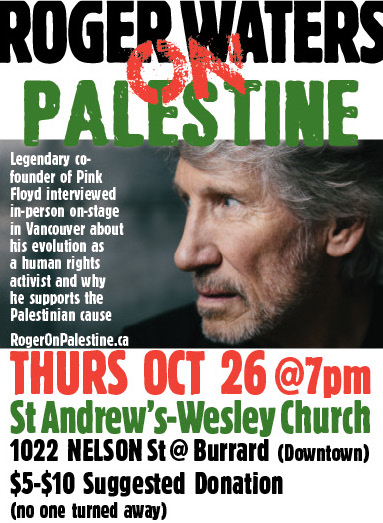
- SFSC Event Oct 26: Roger Waters talks Palestine live on-stage at Vancouver forum
- SFSC Event April 5: Why is Canadian professor Hassan Diab still held in French jail? What can we do?
- straight.com: Free speech advocate and long-time Vancouver library employee Brian Campbell dies
- IJV: Remembering Brian Campbell
- SFSC – Brian Campbell lived to make the world a better place
- Corporate SLAPP vs Free Speech
- BCCLA: On the BDS movement and the narrowing of acceptable speech
- EI: Thought crimes in Trudeau’s Canada
- Globe & Mail: Canadian politicians love the Charter of Rights and Freedoms — except when it involves Israel
- rabble.ca: Liberals’ shameful BDS stand gives carte blanche to Israel
- ipolitics.ca: Boycott Israel – or don’t. Either way, it’s none of Ottawa’s business.
- Globe and Mail: Parliament votes to reject Israel boycott campaign
- SFSC Letter: To the Moderator of the United Church of Canada
- SFSC Letter: Greatest Threat to Free Speech in the West
- United Church Moderator expresses “strong concern” to Trudeau re BDS motion
- CBC: Liberals denounce and agree with Tory motion condemning Israel boycotters
- The intercept: Criminalizing Activism Against Israeli Occupation
- SFSC: Valentino’s Ghost and Wanted 18 – Vancouver Film Premieres Feb 13
- SFSC Event: Stolen Land – First Nations, Palestinians at the Frontline of Resistance
- Environmental Defence: Victory! Ontario citizens freed from the risk of being SLAPPed when speaking out to protect their communities
- SFSC Event Sept 24: Big Brother is Watching – A discussion of Bills C51 & C24
- SFSC Article: Bill C51 – Zero Tolerance for Criticism of Israel
- Vancouver Sun: Award-winning library director calls terrorism bill this generation’s ‘most repressive’ legislation
- SFSC Video: Singing the Praises of the ‘Anti-Terrorist’ Bill C-51
SFSC Event Oct 26: Roger Waters talks Palestine live on-stage at Vancouver forum
Comments Off on SFSC Event Oct 26: Roger Waters talks Palestine live on-stage at Vancouver forum
Tagged BDS, SFSC Event
Why Seriously Free Speech?
Over the last decade more and more people have started questioning the policies and actions of the State of Israel. In response, some of Israel’s supporters have increasingly tried to suppress open political debate of Palestine/Israel. This campaign to vilify, intimidate and harass Israel’s critics has intensified since December 2009 when live video showed Israel’s treatment of Palestinians during its military assault on Gaza.
Comments Off on Why Seriously Free Speech?
Posted in SFSC
SFSC Event Nov 8: “Occupation of the [North] American Mind” Film screening
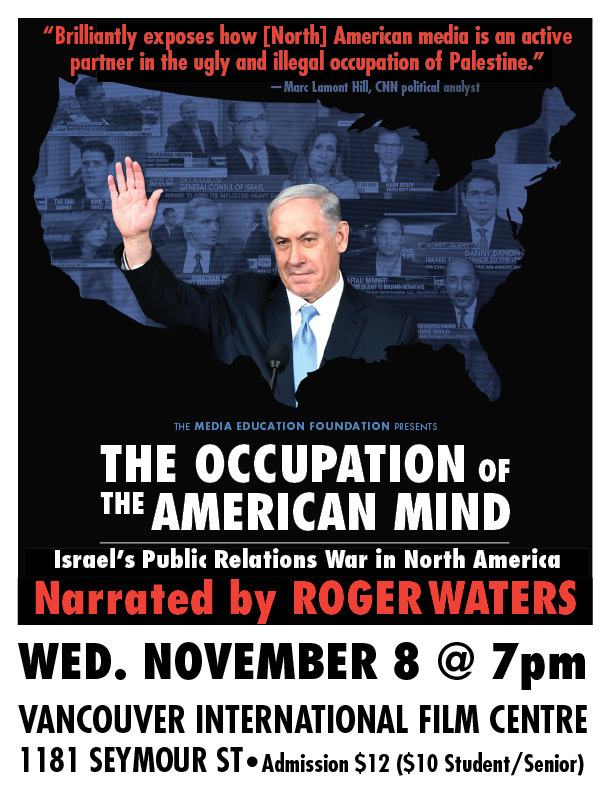
Presented by Seriously Free Speech and Independent Jewish Voices.
Narrated by Roger Waters, this compelling and important film examines how the Israeli government, the U.S. government, and pro-Israel lobbying groups have waged a series of coordinated PR campaigns to manage political fallout from Israel’s illegal occupation of Palestinian land and shape North American media coverage of the Israeli-Palestinian conflict in Israel’s favor.
“A vital and unmissable film.” The Nation
Website and trailer: http://mediaed.org/occupationmovie/about.html
PLEASE SPREAD THE WORD ON FACEBOOK
To invite your friends to the facebook event goto rogeronpalestine.ca and share the event.
Comments Off on SFSC Event Nov 8: “Occupation of the [North] American Mind” Film screening
Tagged SFSC Event
SFSC Event April 5: Why is Canadian professor Hassan Diab still held in French jail? What can we do?
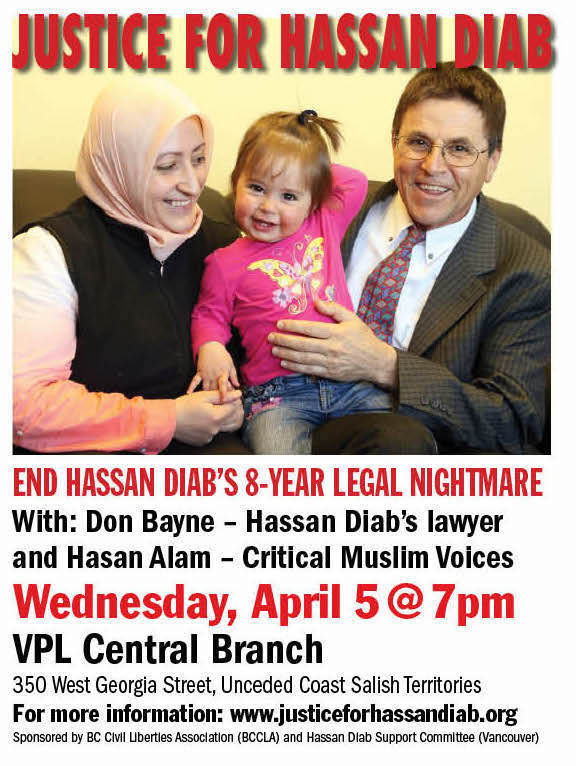 Dr. Hassan Diab, a sociology professor at the University of Ottawa, was arrested in 2008 in connection with the deadly bombing of a Paris synagogue that occurred in 1980. Throughout his long ordeal – imprisoned and under house arrest in Canada for 6 years, extradited to France in 2014, and now nearly 2 ½ years in a French prison without being charged – Diab has maintained his innocence.
The Canadian judge who extradited Diab described the French case as “weak” and concluded that a conviction was unlikely if tried in a Canadian court. However, France’s new anti-terrorism laws permit courts to rely on secret “intelligence,” that has never been disclosed to Mr. Diab and could be potentially derived from torture. Human rights and civil liberties groups–including the BCCLA–opposed the extradition.
Don Bayne, a leading criminal defence lawyer who fought the six-year extradition battle pro bono, called Diab “Canada’s Alfred Dreyfus.” Diab, a Lebanon-born Muslim, is a victim of mistaken identity, sacrificed to make France look tough on terrorism. Dreyfus was a French Jew wrongly accused a century ago – a time when anti-Semitisim was strong as Islamophobia is today.
The support committee calls on the Liberal government to intervene with French authorities. “We have the gravest concern that this case represents a profound miscarriage of justice and the time to act is long overdue. One way to oppose Islamophobia is to support Justice for Hassan Diab.”
www.justiceforhassandiab.org
Facebook: friendsofhassandiab Twitter: @friendsofhdiab
Sponsored by BC Civil Liberties Association (BCCLA) and Hassan Diab Support Committee (Vancouver). Endorsed by Critical Muslim Voices, Independent Jewish Voices, Canadian Association of University Teachers and Seriously Free Speech Committee.
Comments Off on SFSC Event April 5: Why is Canadian professor Hassan Diab still held in French jail? What can we do?
Posted in Media, Other Campaigns, SFSC
Tagged SFSC Event
straight.com: Free speech advocate and long-time Vancouver library employee Brian Campbell dies
by Charlie Smith @ straight.com
A pioneering activist and former Vancouver Public Library staff member has died.
Brian Campbell passed away shortly after Christmas from lung cancer after spending his adult life trying to improve the lives of average people around the world.
When he retired in 2006 as the Vancouver Public Library’s director of systems and special projects, Campbell had distinguished himself as an outspoken advocate for freedom of information and expanding Internet access. He also advocated for the VPL engaging in an evidence-based public education program about drug addiction.
In 2015, the Canadian Library Association awarded Campbell with its Advancement of Intellectual Freedom in Canada Award. Continue reading
IJV: Remembering Brian Campbell
Independent Jewish Voices Canada
Vancouver’s activist community lost a valued friend in December, when Brian Campbell died of lung cancer. Brian was a man of rare depth, a fierce advocate for human rights, a committed socialist, a tireless organizer, and a tender and understanding friend. He was a dependable presence on picket lines and marches, his strong baritone chanting and singing above the crowd.
As Systems and Planning Director of the Vancouver Public Library, Brian made a lifetime career – inside libraries and out – of defending free speech and promoting free and equal access to information. That commitment earned him the Canadian Library Association’s award for Advancement of Intellectual Freedom in Canada, in 2015. After retiring from the VPL, he focused his formidable energies and intellect on progressive causes, including the Boycott Israel Apartheid Campaign (BIAC) and the Seriously Free Speech Committee (SFSC). Continue reading
Comments Off on IJV: Remembering Brian Campbell
Posted in SFSC
SFSC – Brian Campbell lived to make the world a better place

It is with great sadness that we report that Brian Campbell, one of the founders of the Seriously Free Speech Committee (SFSC), died from cancer on Dec. 27, 2016 at the age of 72.
Brian helped organize the SFSC in 2008 to defend three people being sued by CanWest for parodying the Vancouver Sun’s biased pro-Israel coverage. Nine years later, the group continues to defend individuals and organizations that are attacked for supporting Palestine, falsely accused of anti-semitism, and threatened with lawsuits and the loss of tenure, research grants, or even their jobs for criticizing Israel.
Throughout his 25-year career at the Vancouver Public Library, Brian defended free speech, promoted free and equal access to information, and was part of the original campaign to push the BC government to adopt a freedom of information law. In 2015, the Canadian Library Association named him recipient of their Advancement of Intellectual Freedom in Canada Award.
Brian spearheaded numerous SFSC campaigns, fighting the passage of Bill C-51, Canada’s draconian anti-terrorism law passed by the Harper government and urging its repeal by the Trudeau Liberals; organising against the threat free speech from federal and provincial resolutions condemning BDS (Boycott Divestment Sanctions campaign calling on Israel to abide by international law) supporters; calling for the reinstatement of fired University of Illinois professor Steven Salaita for tweets expressing his anger over Israel’s brutal bombing of Gaza; and fighting efforts to criminalize opposition to Israel’s policies and actions, including the so-called Canadian Parliamentary Coalition to Combat Anti-Semitism, New York’s threat to cut off funding to public bodies that divest from Israel or France’s anti-BDS law that has put supporters in jail.
A long-time socialist, Brian was a major force in the Boycott Israeli Apartheid Campaign and other movements, including Eco-Socialists and Stop Kinder-Morgan. Brian generously contributed time, money and hard work to the many progressive causes he supported.

Corporate SLAPP vs Free Speech
*NEW – Watch Video of Michael Vonn’s presentation from SLAPP vs Free Speech
Continue reading
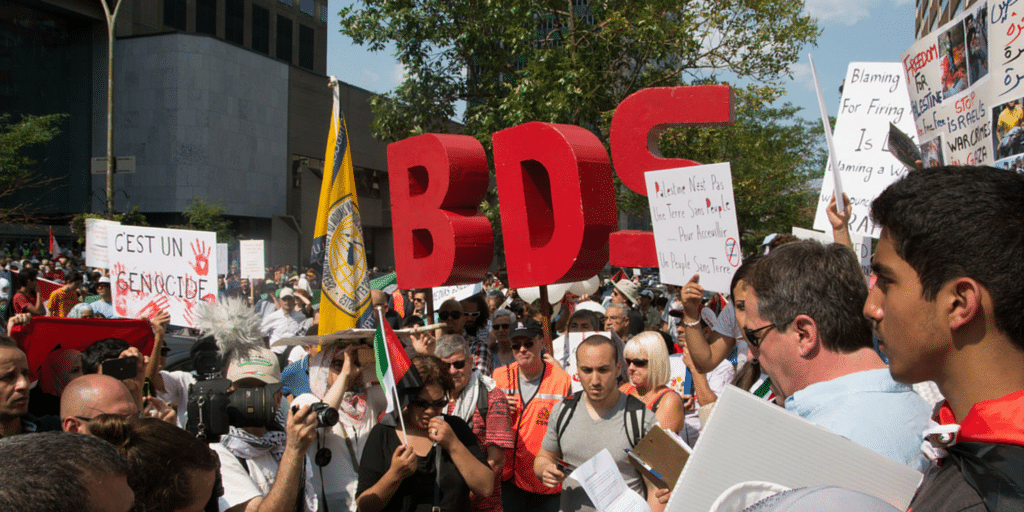
BCCLA: On the BDS movement and the narrowing of acceptable speech
 BC Civil Liberties Association March 8, 2016
On the Boycott, Divestment and Sanctions (BDS) movement and the narrowing of acceptable speech
Individual Canadians must feel completely free to express themselves on matters of public importance, whether or not their views are supported by a majority of the Members of Parliament. Constitutional rights must come before foreign policy decisions.
by Alyssa Stryker, BCCLA
On Tuesday, February 23, the House of Commons voted to formally condemn the Boycott, Divestment and Sanctions (BDS) campaign. The full text of the motion, introduced by the Conservatives, reads:
“That, given Canada and Israel share a long history of friendship as well as economic and diplomatic relations, the House reject the Boycott, Divestment and Sanctions (BDS) movement, which promotes the demonization and delegitimization of the State of Israel, and call upon the government to condemn any and all attempts by Canadian organizations, groups or individuals to promote the BDS movement, both here at home and abroad.”
While professing unhappiness about supporting the motion, the Liberals – confusingly – voted for it anyway, showing themselves a little too willing to narrow the range of political perspectives that Canada’s democracy can accommodate. The New Democrats and the Bloc Québécois both opposed the motion. Continue reading
Comments Off on BCCLA: On the BDS movement and the narrowing of acceptable speech
Posted in Media
Tagged BDS, Parliament Condemn BDS
EI: Thought crimes in Trudeau’s Canada
 Davide Mastracci, The Electronic Intifada, 8 March 2016
The Liberal Party of Canada, which is led by Prime Minister Justin Trudeau and came to power in October 2015, brands itself as a progressive alternative to the Conservatives. In some respects, they are: the Liberals have ended airstrikes in Syria, accepted more than 25,000 Syrian refugees and lifted sanctions on Iran.
When it comes to Israel and the Palestinian-led campaign for boycott, divestment and sanctions (BDS), however, the Liberals have continued down the Conservatives’ troubling path, violating Canadians’ wishes and the Charter of Rights and Freedoms along the way.
On 22 February the House of Commons passed a motion by an overwhelming margin of 229-51 votes in condemnation of the BDS movement.
The Liberals have a majority in the House of Commons and the motion, introduced by two Conservative members of parliament, would not have passed without them. Only two of 184 Liberal MPs voted against the motion. Continue reading
Comments Off on EI: Thought crimes in Trudeau’s Canada
Posted in Media
Tagged BDS, Parliament Condemn BDS
Globe & Mail: Canadian politicians love the Charter of Rights and Freedoms — except when it involves Israel
 GERALD CAPLAN, Globe and Mail, Monday, Mar. 07, 2016
When it suits them, Canadian politicians embrace the rights established in the Canadian Charter of Rights and Freedoms. But there are limits, and most of them unaccountably seem to have to do with Israel.
Two years ago, for example, then-prime minister Stephen Harper insisted that Israeli policies should not be criticized, especially in public. To criticize Israel, he said, is to be guilty of “the new anti-Semitism. … It targets the Jewish people by targeting Israel.”
Why it was anti-Semitic to criticize the Israel government for its housing or land or human-rights policies, as indeed so many Israelis do, Mr. Harper never explained. Continue reading
Comments Off on Globe & Mail: Canadian politicians love the Charter of Rights and Freedoms — except when it involves Israel
Posted in Media, Other Campaigns
Tagged BDS, Parliament Condemn BDS, printonline